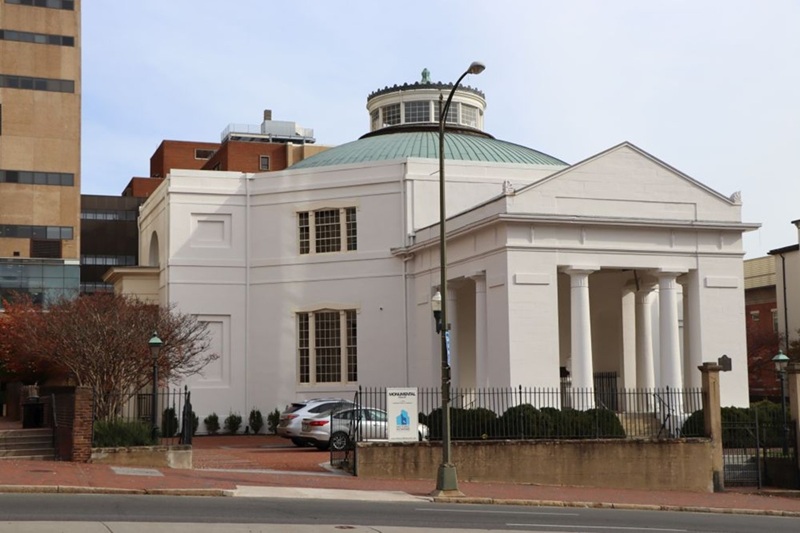
Owned by the Historic Richmond Foundation, Monumental Church is a state and national landmark that was built in 1812-14 to serve as a memorial to the 72 people who perished in an 1811 theater fire at the same site.
By Elizabeth Lipford | Architectural Historian & DHR Easement Stewardship Specialist
Monumental Church was built in 1814 as a memorial to the 72 people who died in the 1811 Richmond Theatre fire. A grieving community quickly mobilized to erect a common crypt on site for the burial of the victims, both black and white, followed by the decision to build a church over the crypt. After an open competition, American architect Robert Mills was selected, out-competing his mentor and teacher, Benjamin Henry Latrobe. Mills designed an elegant Greek Revival church that employed Roman and Egyptian motifs evoking a funerary theme, which was revealed in details such as the memorial urn, the portico frieze, the main cornice, and the interior and exterior columns. A Delorme dome with cupola covers the octagonal-shaped church, which features large, multi-light windows that allow for generous amounts of natural light in the auditorium style sanctuary. Long recognized as an architectural landmark, it was listed on the Virginia Landmarks Register in 1968, the National Register of Historic Places in 1969, and designated a National Historic Landmark by the Secretary of the Interior in 1971. Monumental Church served as an Episcopal Church from 1814 until 1965 and has associations with numerous individuals from Richmond and Virginia history, including the Marquis de Lafayette, Edgar Allen Poe, John Marshall, and several Virginia governors.
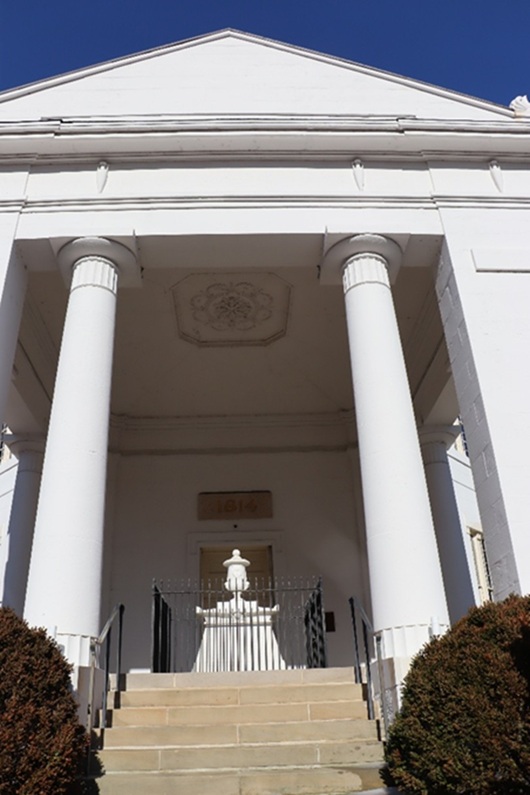
When the Historic Richmond Foundation (HRF) acquired the partially restored Monumental Church from the Medical College of Virginia Foundation in 1983 they did not envision permanent ownership. At that time, HRF was organized to leverage funds to purchase and stabilize threatened Richmond landmarks until such time as a new use and a new owner could be found. Upon acquisition of Monumental Church, HRF focused on the immediate need to repair extensive damage from ongoing leaks. The pivotal moment that changed their trajectory came in 1999, when the original marble urn under the portico was damaged. It became clear that extraordinary measures would be needed to address the complicated preservation issues. Partnering with the William Byrd Branch of the Association for the Preservation of Virginia Antiquities, they committed to a multi-year, phased restoration effort of the urn and the church. HRF was in it for the long term. In 2004 they received a $320,000 Save America’s Treasures grant, which required a perpetual easement that would be held by the Board of Historic Resources and administered by the Department of Historic Resources (DHR). The easement ensured that the building will never be intentionally demolished or altered in a way that is not consistent with the Secretary of the Interior’s Standards for Rehabilitation. Provisions also included protection of archaeological resources on the entire parcel. Since the easement was recorded, HRF and DHR have worked together on decisions that assist HRF with their goals for the property.
Danielle Worthing Porter, Director of Preservation Services for HRF, describes stewardship of Monumental Church as multi-faceted. She notes that HRF is not a museum organization with a curatorial staff, yet they take seriously the responsibility of interpreting the building’s history through careful restoration and the development of educational material, exhibits, and visitor opportunities. Then there is the stewardship of the building itself, which has complex features such as a domed roof on an octagonal structure. While considered a design signature of architect Robert Mills, it is a roof for which water always finds a way in. With no apparent permanent solution that would not alter the integrity of its design, HRF continues to study, analyze, and repair the roof as issues present themselves.
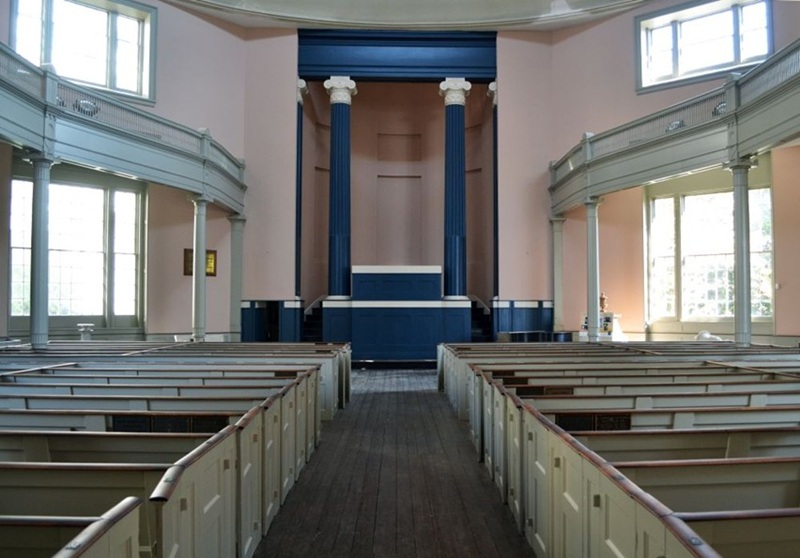
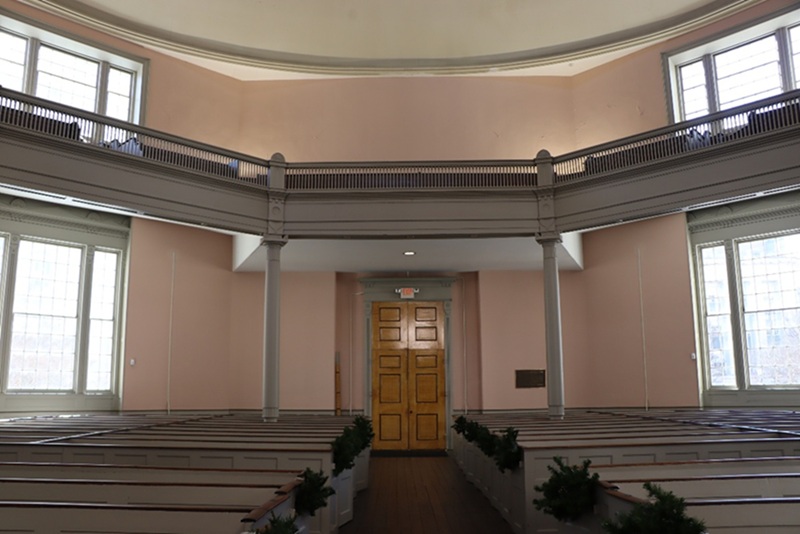
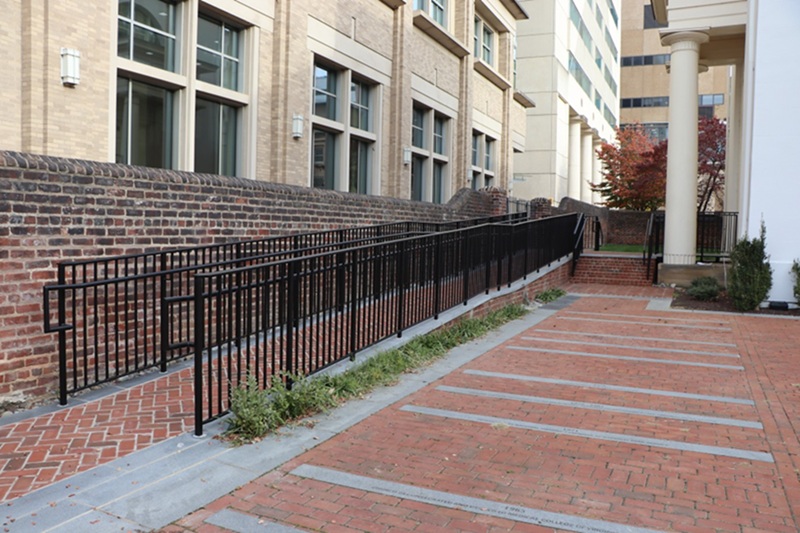
Stewarding the building for use in the 21st century has its challenges as well. Historic wooden box pews limit capacity for events. The building is equipped with heating, air conditioning, and electricity, but there are no bathrooms. Parking is limited on the site. It is a priority of HRF to continually improve the facility for visitors. Several years ago, a ramp system was installed at the primary entrance on the west elevation. In 2025, HRF was awarded a Virginia250 Preservation grant from DHR to upgrade existing and install new lighting elements in the sanctuary. The completed project enhances the visitor experience, especially for evening events, and provides for safer movement in the space. Always looking to the future, HRF is once again planning for the next phase of stewarding this important historic landmark.
The church is open for scheduled tours and events through the Historic Richmond Foundation. For more information about events and the restoration and history of the church, visit the HRF website.