Here’s the problem with taking in archaeological collections to store in perpetuity: eventually, you run out of space.
By Allison Mueller, DHR Senior Curator, and Serena Soterakopoulos, DHR Collections Manager
Despite popular portrayals in media, museums are not filled with unlimited shelves and glass cases for storing thousands of years of priceless artifacts. The massive warehouses of Indiana Jones fame are the stuff of dreams for museum staff rather than our reality. Instead, museums and historic resource institutions like Virginia’s Department of Historic Resources (DHR) typically have small, quirky spaces that are fully at capacity for storing collections.
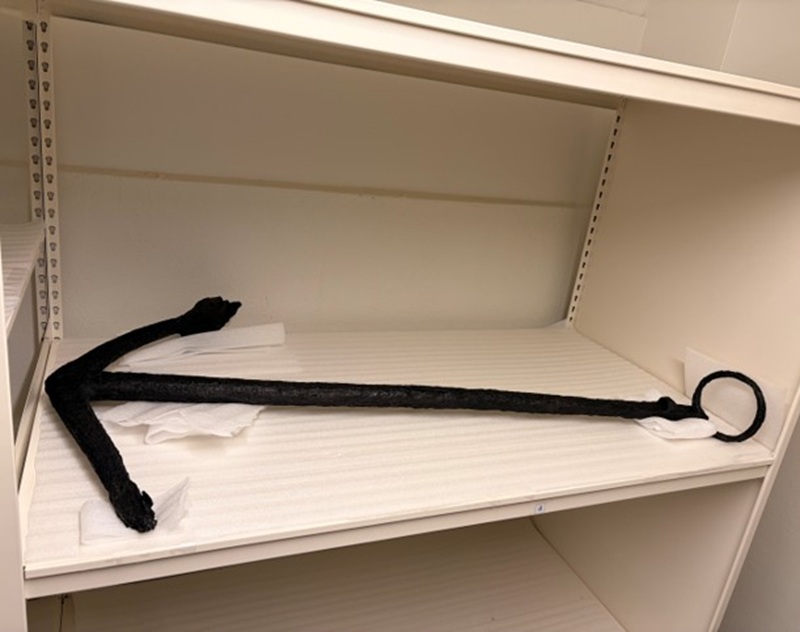
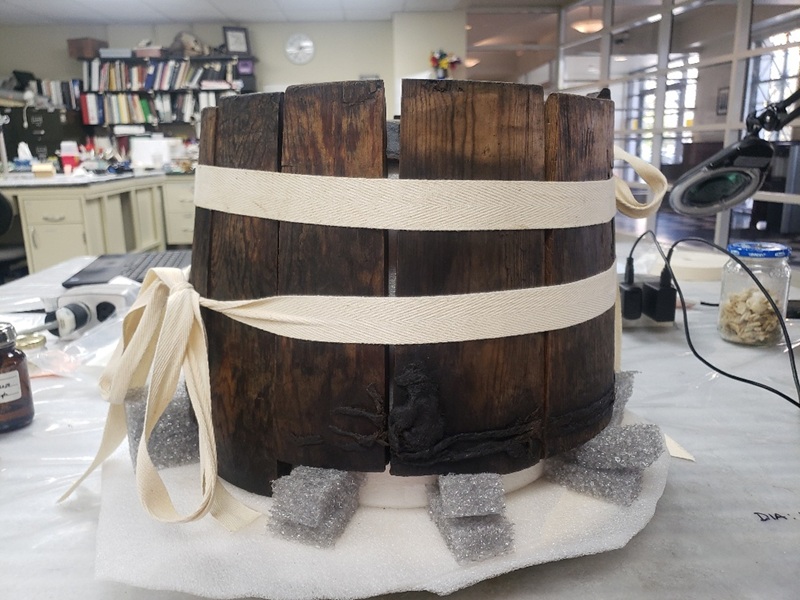
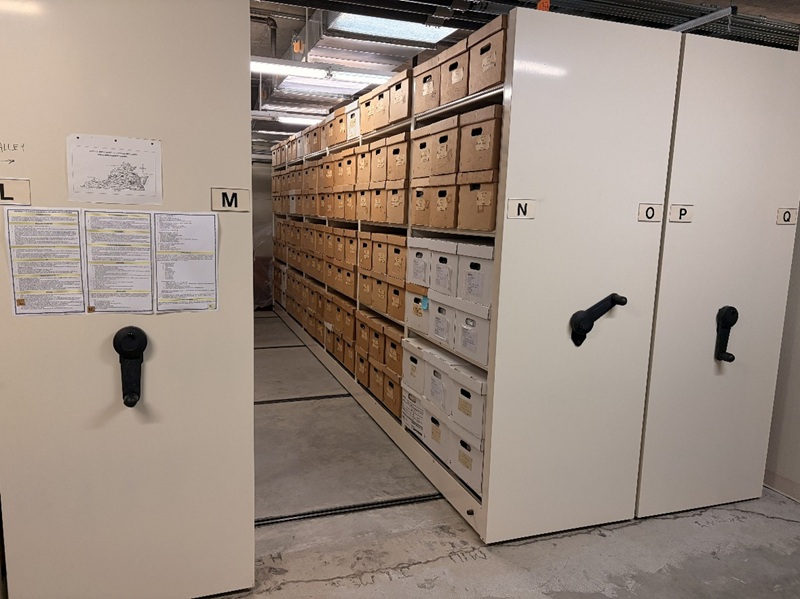
As a state government agency, DHR is tasked with the perpetual care of the Commonwealth’s archaeological collections. In order to provide that care, DHR has had to move around to keep finding more space to store the objects. Since moving to Richmond’s Museum District in 1998, DHR has leased building space used for offices, a library and archive, a conservation lab, and a collections repository from the Virginia Museum of History and Culture (VMHC). The collections repository is where DHR stores and curates roughly 10,000 boxes of archaeological artifacts, as well as about 300 boxes of field records, maps, artifact catalogs, and project documentation, on high-density mobile shelving units. That’s not to mention a wide range of “oversized” artifacts—because not all artifacts are created equal, and not all of them like to fit into a standard-sized box. These oversized artifacts, such as barrel hoops, swords, ship parts, and large agricultural equipment, have historically been housed in whatever space was available: atop or alongside artifact boxes on the high-density shelving, or, because of their size, on wire rolling racks or pallets. Storing artifacts in these ways is not ideal for many reasons. It’s not the best use of space; it isn’t ideal for safety reasons; it’s not favorable for artifact stability; and it significantly contributes to the need for more storage. Among the millions of artifacts, thousands of boxes, hundreds of oversized objects, and many other materials, DHR’s repository was quite literally bursting at the seams as of last year.
While this struggle for space continues, DHR’s collection of artifacts grows each and every year with new projects and legacy collections alike arriving from cultural resource management firms, private donors, descendant communities, Tribal Nations, and federal and state government agencies. So, what can we do to fix (or perhaps more accurately, delay) this lack-of-space problem? Well, that’s a great question.
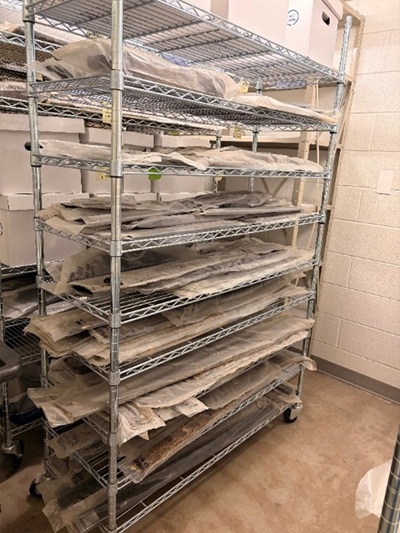
This problem, known in the museum and collection world as the “Curation Crisis,” is affecting everyone. Museums, universities, historic sites, archaeological repositories—we all feel the pressure of the inevitable. Soon, there won’t be enough room to house our ever-growing collections. Shelf space is at a premium, and one of the solutions (albeit a temporary one) that DHR has more recently been able to pursue is the acquisition of additional storage space and shelving.
In 2020, as shelf space quickly dwindled away, DHR completed negotiations with VMHC to expand the DHR repository further into VMHC’s own storage. What had once been a single, large room that held the entirety of the artifacts stewarded by the Commonwealth nearly doubled in size through the newly acquired footprint with the addition of five smaller rooms. While the task of obtaining more space was complete, it then led to the next hurdle: having more physical space does not suddenly mean there are more places to store boxes of artifacts. More wire rolling racks were purchased as a temporary measure to hold the continuous acquisition of artifacts until a more permanent solution could be made. Five years later, after much planning between DHR staff, VMHC staff, consultants, and contractors, a solution was developed that would allow DHR to use this new space to our best advantage.
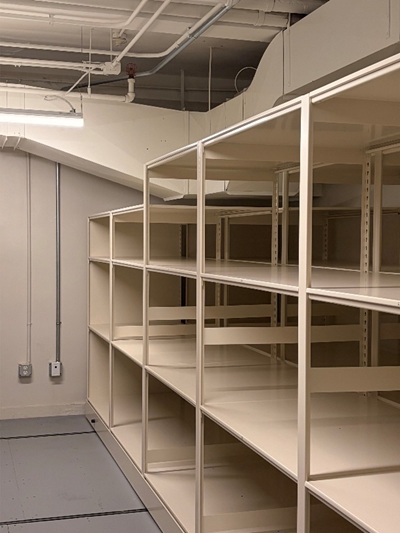
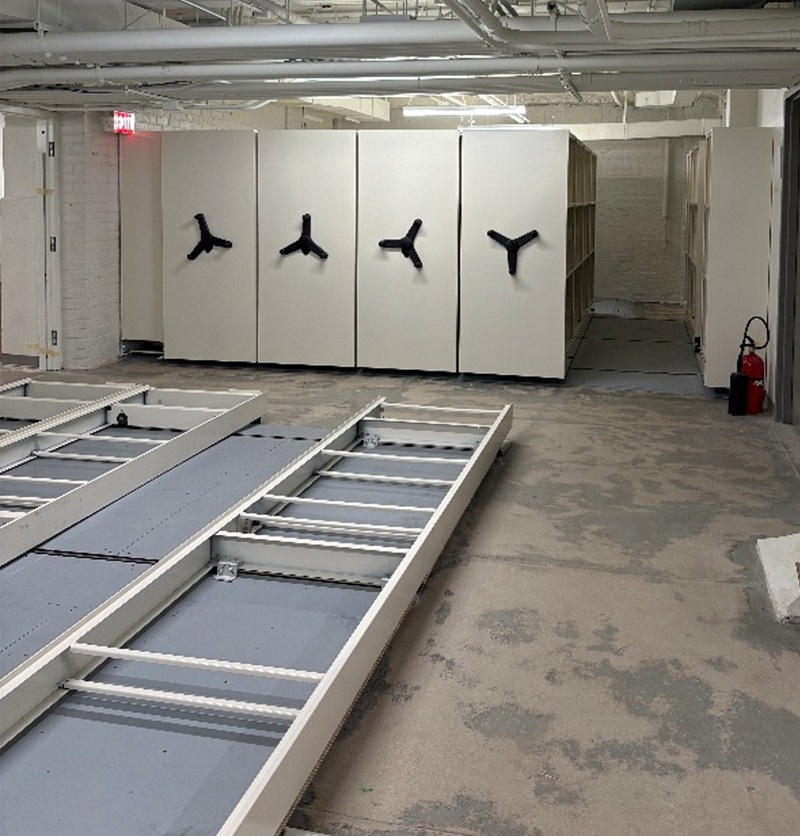
The focus was to incorporate as many high-density mobile shelving units as possible into the newly acquired rooms, although this was no easy task. Since these rooms had a variety of original uses, the spaces were wonky at best, with varying ceiling heights, odd room shapes, weird nooks and crannies, and many other spatial limitations. After consulting with the museum planning team, Wendy Jessup and Associates, to create a comprehensive plan for these new storage spaces, as well as with Virginia’s Tribal Nations for their input on space allocation, DHR contracted Spacesaver Storage Solutions to supply and install new high-density mobile shelving. The Spacesaver team ensured we maximized these quirky spaces, resulting in some shelves being different heights or sizes to accommodate changes in the physical space. After all that planning and prepping, construction began in November 2025 and was completed by February 2026.
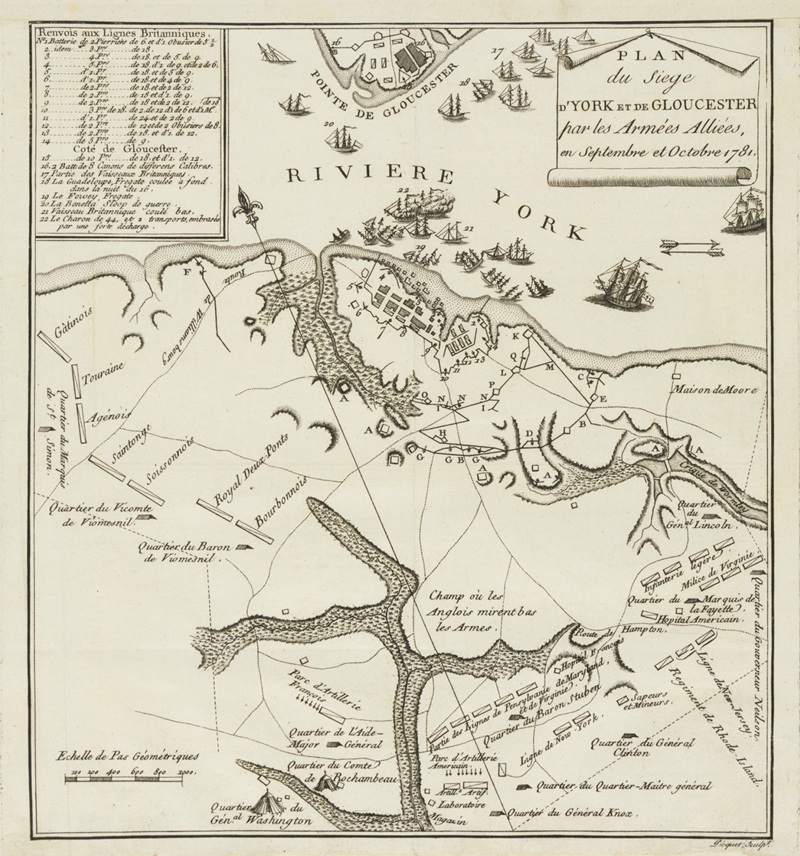
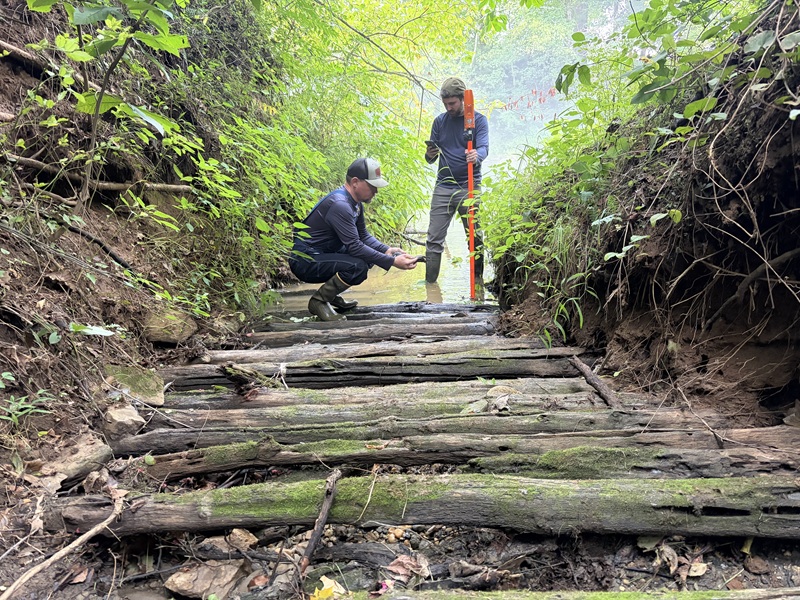
Besides ensuring adequate space for standard-sized boxes that contain the majority of DHR’s archaeological collections, accommodating the oversized artifacts was also considered during planning stages and incorporated into the final design. The first of the five new storage rooms was specifically designed to hold these larger, odd-shaped collections. The high-density shelving was arranged on wider, shorter, and taller scales than those standardly used for boxes. The purpose of this was to account for large artifacts, like an anchor, and long, narrow artifacts, like wood planks from a Revolutionary War shipwreck. Having this specialized shelving removes the need for oversized artifacts to take up space on box shelves or on wire rolling racks, an ideal solution for maintaining artifact condition and safety.
Now that DHR has installed these new shelves, we will be filling them up with both new and old collections. There is, and will, be a massive reorganization effort led by the collections team to optimize the spaces and make room for collections of all sizes for years to come. However, we all must remember that space is not infinite, as much as we would like it to be, and one day in the not-so-distant future these new spaces will also be filled, and we will yet again be searching for ways to combat the curation crisis.