Virginia Department of Historic Resources
For Immediate Release
Contact:
Ivy Tan
Marketing & Communications Manager
ivy.tan@dhr.virginia.gov
804-482-6445
Virginia Designates 7 Historic Sites as State Landmarks
—The newly designated landmarks are in the county of Bedford; in the cities of Newport News, Suffolk, Lynchburg, and Roanoke; in the Hanover County town of Ashland and in the Fauquier County town of Warrenton—
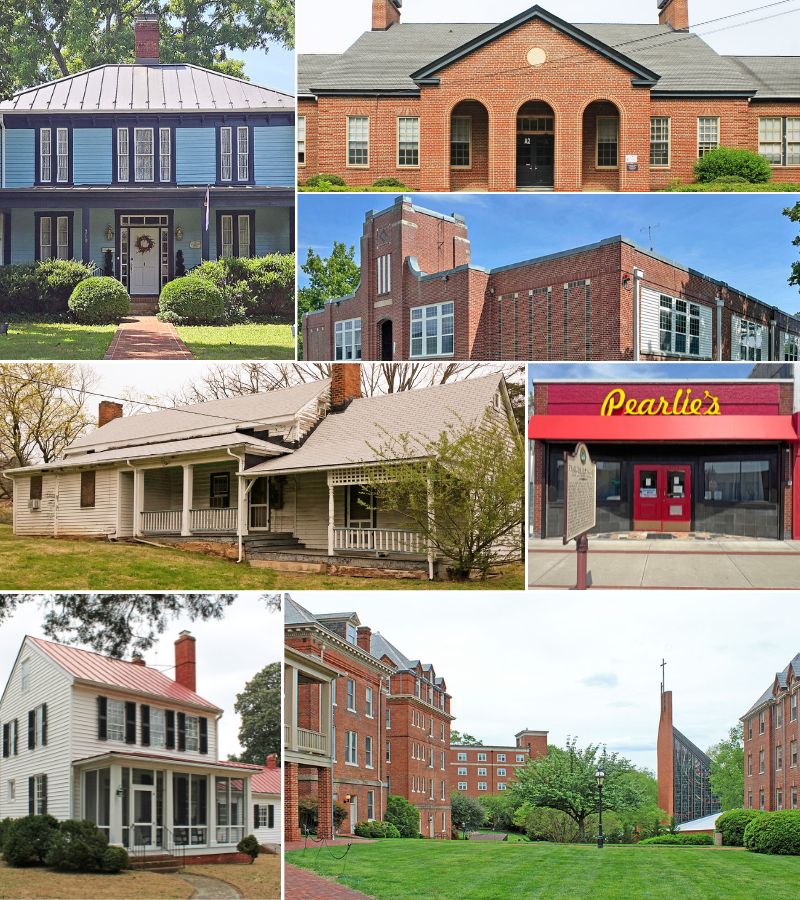
RICHMOND – Among the seven places recently listed in the Virginia Landmarks Register are a historic district that encompasses the campus of one of the earliest and longest-operating women’s colleges in Virginia and the Southern United States; a restaurant building in Newport News owned and operated by African Americans that appeared multiple times in the Commonwealth’s Green Book during the Jim Crow era; and a late-19th-century house that features a locally popular layout in rural Fauquier County.
The Commonwealth’s Board of Historic Resources approved these properties for designation on the Virginia Landmarks Register (VLR) during its quarterly public meeting on March 19, 2026, in Richmond. The VLR is the commonwealth’s official list of places of historic, architectural, archaeological, and cultural significance.
At the conclusion of its meeting, the Board approved the following places for listing in the VLR:
In the state’s Eastern Region,
- Since the 1920s, 2108 Jefferson Avenue—currently the site of Pearlie’s Restaurant—in the East End community of the City of Newport News has been home to a variety of restaurants owned and operated by African Americans, including African American women. In 1962 the present Commercial-style building, constructed ca. 1951, was listed as Grant’s Restaurant in Virginia’s Negro Motorist Green Book, a guide to hotels, restaurants, service stations, and other businesses that welcomed Black travelers during Jim Crow. 2108 Jefferson Avenue was listed in the Green Book as The Tavern restaurant from 1939 to 1950. The building is the only documented Green Book resource in Newport News that has remained under the same use as its Green Book 2108 Jefferson Avenue was designated a landmark under The Negro Traveler’s Green Book in Virginia Multiple Property Documentation Form (MPD), which the Board of Historic Resources also approved during its meeting on March 19.
- In the City of Suffolk, the Ames-Old Farm exemplifies the typical home of a yeoman farmer in Virginia’s Tidewater region in the early 19th century. In addition to the farm’s original, two-and-a-half-story main house, which was built in 1815 in the Federal architectural style, the property also encompasses six agricultural outbuildings, all of which were built in the mid- to late 19th century and early 20th century. In around 1875 the house was expanded to include a dining room and kitchen, marking the first phase of modifications, before additional rooms were added in 1965 and a garage in 1985. The property’s evolution reflects its owners’ efforts to accommodate shifting domestic and agricultural needs at the turn of the 20th century.
- Henry Clay Elementary School in the Hanover County town of Ashland was built in 1934 for White students using funds from the Public Works Administration and the Virginia Literary Fund. Initially completed as a one-story brick Colonial Revival building featuring 13 classrooms, the school was expanded in subsequent decades to include additional classrooms, a library, and a covered walkway to connect the school with the Ashland War Memorial Building, which was constructed about 75 yards west of the school in 1951. Henry Clay Elementary closed in the spring of 2024.
In the state’s Northern Region,
- The Saunders House in the Fauquier County town of Warrenton was built in 1870 for the mercantile Saunders family during the Reconstruction period as a way to protect family assets from creditors. Designed in the Italianate architectural style, the house features a floorplan that is notably popular in rural parts of Fauquier County.
In Virginia’s Western Region,
- From 1870, the year public education was established in Virginia, through the early 20th century, rural schools were small one- or two-room buildings that lacked uniformity. Montvale High School in Bedford County, built in 1930 for White students in grades one through twelve, is representative of the Commonwealth’s efforts to improve public education in rural Virginia during the Progressive Era by consolidating and standardizing schools. Designed in the Colonial Revival architectural style with Art Deco influences, the school’s consistent expansion from the 1930s to the 1960s demonstrates its increasing importance as a community educational center as well as a social hub in rural Bedford County during the 20th century.
- Located in the Rivermont neighborhood in the City of Lynchburg, the Randolph-Macon Woman’s College Historic District includes the 53-acre historic campus of Randolph-Macon Woman’s College, one of the earliest and longest-operating women’s colleges in the South. Established in 1891, the college evolved over time in response to rising demand for higher education as women’s roles in society changed following the Civil War. The campus buildings, which date from 1891 to 1975, were designed by prominent local and national architects and encompass a wide variety of architectural styles.
- Built in phases between ca. 1820 and ca. 1850, Fishburn Park Keeper’s Cottage is possibly the oldest surviving building within the City of Roanoke. The cottage exemplifies an early 19th-century hewn-log farmhouse that was enlarged to accommodate a growing family with the addition of lateral wings, one built of logs and the other of timber frame. While both types of construction were once common in Southwest Virginia dwellings, the assortment of joinery techniques in Keeper’s Cottage makes it a unique building in the region.
DHR will forward the documentation for the newly listed VLR sites to the National Park Service for nomination to the NRHP. Listing a property in the state or national registers is honorary and sets no restrictions on what owners may do with their property. The designation is foremost an invitation to learn about and experience authentic and significant places in Virginia’s history. Designating a property to the state or national registers—either individually or as a contributing building in a historic district—provides an owner the opportunity to pursue historic rehabilitation tax credit improvements to the building. Tax credit projects must comply with the Secretary of Interior’s Standards for Rehabilitation.
###