
Virginia Department of Historic Resources
For Immediate Release
Contact:
Ivy Tan
Marketing & Communications Manager
ivy.tan@dhr.virginia.gov
804-482-6445
Virginia Designates 8 Historic Sites as State Landmarks
—The newly designated landmarks are in the counties of Arlington, Bath, Accomack, Frederick, Loudoun, and Pittsylvania, in the city of Petersburg, and in the Shenandoah County town of Mount Jackson—
RICHMOND – Among the eight places recently listed in the Virginia Landmarks Register are a historic district on Virginia’s Eastern Shore known for hunting and fishing; a 20th-century airfield in the northern region built for resort goers during the early days of commercial air travel; and a mill dam and mill pond complex that served as a local recreational and social hub in Southwest Virginia in the early and mid-20th century.
The Commonwealth’s Board of Historic Resources approved these properties for designation on the Virginia Landmarks Register (VLR) during its quarterly public meeting on December 11, 2025, in Richmond. The VLR is the commonwealth’s official list of places of historic, architectural, archaeological, and cultural significance.
At the conclusion of its meeting, the Board approved the following places for listing in the VLR:
In the state’s Eastern Region,
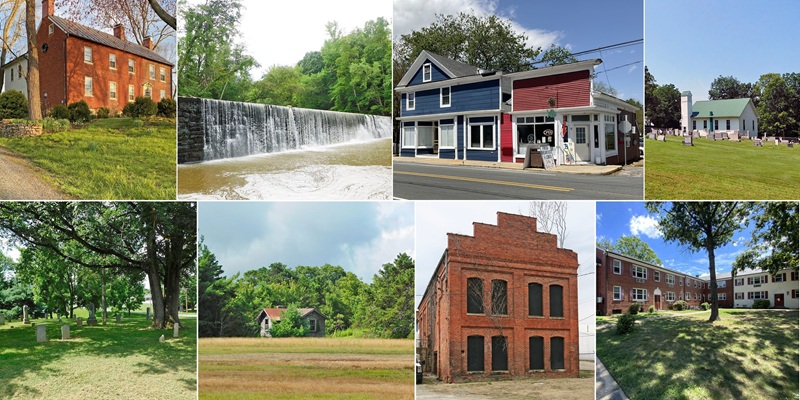
- The Petersburg Gas Company building in the City of Petersburg was built in 1851 for the Petersburg Gas Company, which manufactured gas for government, commercial, and residential use for over a century, first for lighting and later for heating and power. While the building was damaged during the Civil War, subsequent renovations as well as the changing trends in production and the variety of uses for its product reflect the development and evolution of the gas industry in Virginia and the United States from the antebellum period through the mid-20th century.
- Encompassing 96 acres on Virginia’s Eastern Shore, Wachapreague Historic District includes the waterfront town of Wachapreague in Accomack County. From the late 19th through early 20th centuries, the town became a destination known to visitors and residents alike for hunting and fishing as well as a commercial center with access to the Wachapreague Channel and the Atlantic Ocean. The historic district consists mainly of residential and commercial buildings constructed in vernacular, Folk Victorian, and other popular architectural styles in the Eastern Shore during the time of the town’s development. While the population of Wachapreague began to decrease in the 1960s, the town continues to draw visitors from across Virginia and beyond.
In the state’s Northern Region,
- The Barcroft Apartments in Arlington County were built between 1941 and 1953 for White middle-class government workers in Washington, D.C. Built in the Colonial Revival architectural style, the Barcroft complex includes 57 multi-family apartment buildings and was designed according to the guidelines of standard garden apartments, a form of housing that was popular in the mid-20th century in Arlington County and other places in Northern Virginia, where there were urgent demands for moderately priced housing due to the influx of workers moving to the area during and after World War II. The Barcroft Apartments is listed in the Virginia Landmarks Register under the Multiple Property Documentation Form, Garden Apartments, Apartment Houses and Apartment Complexes in Arlington County, Virginia: 1934-1954.
- Ingalls Field in Bath County consists of a small terminal building and a pair of grass-covered runways constructed in the 1930s by the Virginia Hot Springs Company, developer of The Homestead resort, which was the county’s primary economic attraction during the 20th century. Located on top of Warm Springs Mountain, the airfield was named after World War I flying ace and Homestead board member David S. Ingalls, who inaugurated the field by landing on it in May 1931. The establishment of Ingalls Field meant that Homestead guests could enjoy the option of air travel during the early days of commercial aviation, which further added to the prestige of the resort experience. The original airfield closed in 1961, after a new terminal and paved runway were built on an adjacent site, though one of the grass runways remains in use.
- Shockeysville Church and Cemetery in northern Frederick County served as the social hub of Shockeysville, a once-thriving village that developed around the wood products industry in the latter half of the 19th century. Evidence suggests that the church and cemetery were established in the early 1870s along a regionally important 18th-century migration route. The current church building was constructed in 1912-13. The cemetery includes more than 160 grave markers of various types and materials dating from the late 19th century to the present day.
- Located in bucolic western Loudoun County, the 30-acre Laurel Hill Farm has embodied the history and agricultural roots of the county since the late 18th century. Over a period of more than 150 years, the property evolved to include several outbuildings and structures that highlight shifting agricultural practices at the farm, including wheat and dairy farming as well as the adoption of machines in the 20th century. Originally built circa 1793 as a two-story, Federal-style brick dwelling, the property’s main farmhouse expanded in subsequent decades to include additions that reflect changes in local building trends and the fluctuating wealth of its owners during the Civil War and post-Reconstruction eras and the 20th century.
- Mount Jackson Colored Cemetery served as a burial ground for the African American community in the Shenandoah County town of Mount Jackson starting in the late 19th century. The cemetery, which first appeared on record in 1874 in a deed, contains 56 marked burials and 390 grave-like anomalies identified by a recent ground penetrating radar (GPR) survey. In the 20th century, the cemetery was under the charge of Mount Jackson’s Black Baptist and Methodist congregations, members of which were listed as trustees when a small parcel was added to the cemetery in 1924. Grave markers range from uninscribed fieldstones to decoratively carved marble tombstones and other monuments of various types and materials. The cemetery’s last known interment was in 1972.
In Virginia’s Western Region,
- Located in central Pittsylvania County, the Motley’s Mill Dam and Mill Pond complex served as a social and recreational amenity for the local community from the early to mid-20th century. Developed as early as 1785, the mill’s power source was the head of water impounded by a massive stone dam, which was expanded or rebuilt in 1920 and spans the Banister River, a tributary of the Dan and Roanoke Rivers. In the early and mid-20th century, members of the community used the millpond created by the dam for fishing, swimming, recreational boating, and baptisms, making Motley’s Mill Dam and Mill Pond an important local activity center of the central Pittsylvania County area.
The Board also approved in its December meeting the updated National Register of Historic Places (NRHP) Registration Forms for the properties listed below. The updated forms include revisions to the historic boundaries of properties as well as additional documentation on the historic resources located on those properties.
- In the City of Virginia Beach: updated information and a Boundary Decrease to the Weblin House, and updated information on the Holland-de Witt Cottage
- In the City of Lynchburg: a Boundary Increase to the Court House Hill/Downtown Historic District
DHR will forward the documentation for the newly listed VLR sites to the National Park Service for nomination to the NRHP. Listing a property in the state or national registers is honorary and sets no restrictions on what owners may do with their property. The designation is foremost an invitation to learn about and experience authentic and significant places in Virginia’s history. Designating a property to the state or national registers—either individually or as a contributing building in a historic district—provides an owner the opportunity to pursue historic rehabilitation tax credit improvements to the building. Tax credit projects must comply with the Secretary of Interior’s Standards for Rehabilitation.
###