The writer recalls DHR’s role in the restoration of the Monroe Tomb in Richmond’s Hollywood Cemetery and the reinterment of Eliza’s remains.
By Adrienne Birge-Wilson | Architectural Historian, DHR Review and Compliance Division
In 2025, Elizabeth Kortright Monroe (Eliza), the daughter of James Monroe, the United States’ fifth president, was laid to rest with her family in Hollywood Cemetery in Richmond, Virginia. The tomb of James Monroe is listed in the National Register of Historic Places (NRHP) and Virginia Landmarks Register (VLR), as well as being a National Historic Landmark, the highest honor the National Park Service can bestow upon a property.
James Monroe was first buried at the New York City Marble Cemetery in Manhattan after his death in 1831. He had died while residing with his youngest daughter Maria there. In 1856, New York inquired if Virginia wanted his remains. Virginia's Governor, Henry A. Wise, pursued bringing Monroe home. Monroe moved to his resting place in Hollywood Cemetery in Richmond in 1858.
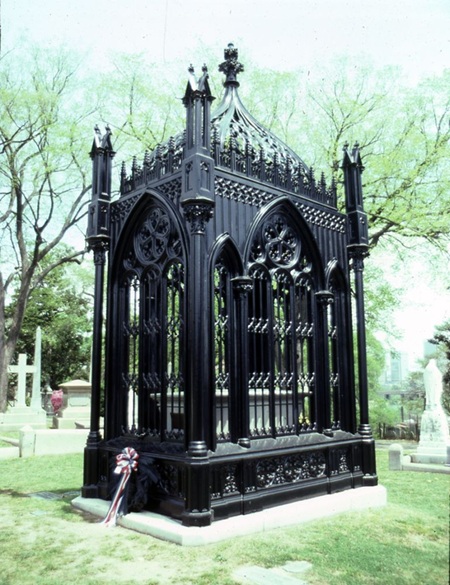
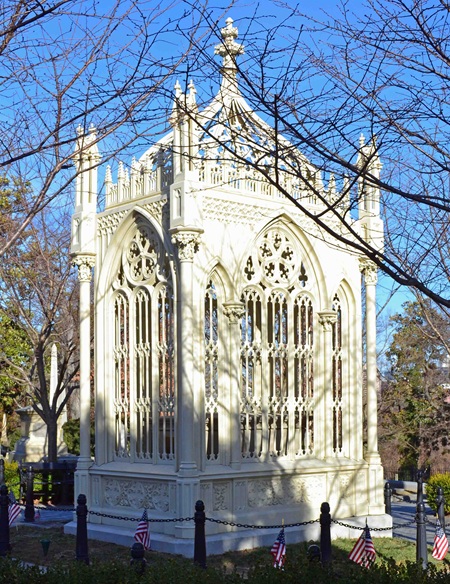
Sometimes referred to as the birdcage, the elaborate Gothic Revival Style cast iron tomb encasement covers the simple granite sarcophagus of James Monroe. It is considered a small-scale masterpiece of cast iron architecture. The tomb is owned by the Commonwealth of Virginia, which initiated and funded the monument's creation. The tomb is currently managed by the Virginia Department of General Services (DGS). Because the Monroe Tomb is listed in the VLR, it is subject to review from DHR’s Division of Review and Compliance in accordance with the Appropriations Act (Biennial Budget Bill) for rehabilitation and restoration projects on state-owned property.
DGS has a history of taking great care in the monument’s upkeep. In 2016, a restoration of the tomb was undertaken. Decades of repairs left the metalwork with filler material, sheet metal patches and layers of caulking, abrasives, and black paint. Paint analysis was done to determine the original color so it could be restored. DGS had consulted with DHR since 2012 on the restoration and treatment plan for this project to ensure a sensitive and appropriate result. Notably, the cast iron structure was returned to its original creamy ivory stone color versus the black that it had been painted over the years.
In 2024, after years of careful archival research, author Barbara VornDick wrote a book about Eliza Monroe that clarified much of the misconceptions about Eliza and her life’s events, although that was not necessarily her intent upon initially pursuing the project. Eliza had a firebrand personality and accompanied her father in the White House (term 1817-1825) as unofficial first lady due to her mother Elizabeth Monroe's chronic illness. The Washington D.C. society quickly maligned her and maintained their stance until long after her death. Her life was beset with tragedies unfolding in short time, first with the death of her husband George Hay in 1830 and her mother’s death two days later. Her father James Monroe died nine months later. James Monroe had given specific instructions to Maria’s husband Samuel Gouverneur, who was executor of the will. He did not take care of Eliza and squandered and withheld her money. Eliza navigated the tricky standing of widows and women in legal affairs, yet her attempts to assert her rightful heritage were fruitless.
Eliza went to Europe as a means of survival and returned to help her daughter Hortensia with her three children in 1834. Hortensia died months later. Eliza made her final trip to France in 1838 and did not return again to the U.S. in life, although this was not her intention. Eliza died in 1840 penniless with no home in France and was buried in a modest, unmarked grave in the American section of Père Lachaise Cemetery. Barbara VornDick reached out to Eliza’s descendants to facilitate bringing her home since it became evident through her research that Eliza would have come back to America if she had been able. In October 2025, Eliza was successfully returned.
As the James Monroe tomb is state-owned, DGS worked with VornDick in submitting the project to DHR’s Review and Compliance Division for review. The choice of monument is usually at the family's discretion within the design/landscape maintenance guardrails established by the cemetery. To be consistent with the other family monuments in the plot, DGS proposed a small flush, granite plaque to mark Eliza’s tomb. DHR provided comments that the reinterment would not result in an adverse impact to the surrounding historic resources.
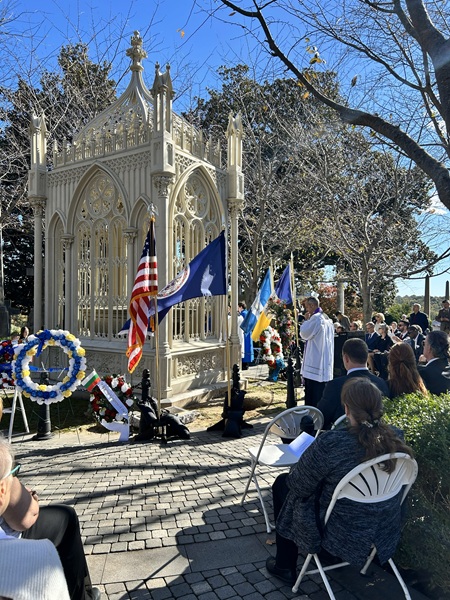
DHR staff attended the reinterment ceremony on October 23, 2025. Descendants of Eliza were in attendance along with dignitaries and the general public.
To purchase a copy of Barbara VornDick's book, Eliza's True Story: The First Biography of President Monroe's Eldest Daughter, visit here.