Digging Into DHR’s Archaeological Data

The author provides an overview of how Virginia’s archaeological data is mined, curated, and added in the Virginia Cultural Resource Information System for use by researchers and other cultural resource management professionals.
By Sean Tennant | Archaeology Data Manager
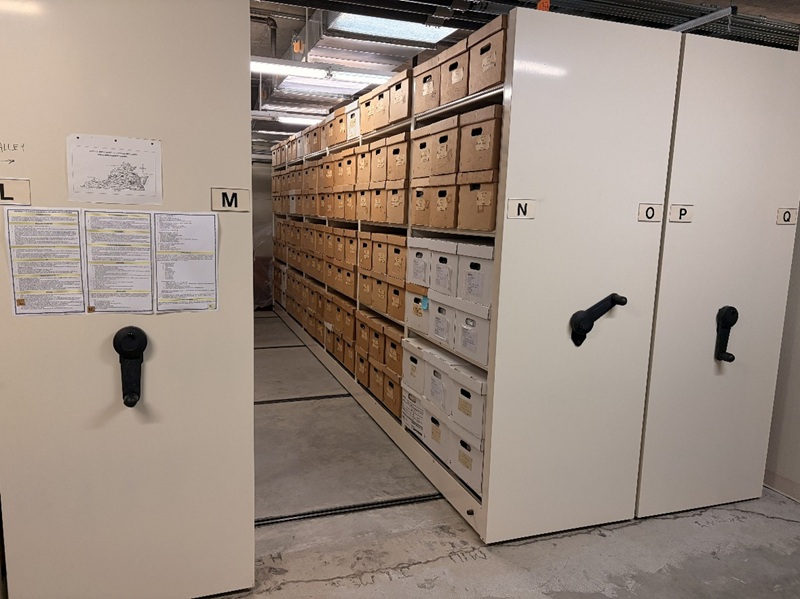
Banker’s boxes of floppy disks and CDs, shelves of archaeological reports stretching back decades, and thousands of electronic site forms. These represent some of the sources of archaeological data that flow into DHR’s information ecosystem, either through chance discoveries or as part of the cultural resource management lifecycle. DHR’s legacy collections represent a valuable resource for the preservation, management, and research of Virginia’s cultural heritage. But how does this information flow from obscurity to illumination?
Since 2013, DHR staff have curated the agency’s legacy archaeological data, along with records about architectural properties, in the Virginia Cultural Resource Information System (VCRIS). While primarily compliance-driven in nature, as a tool for cultural resource management professionals, VCRIS serves a secondary function as an information hub for researchers and heritage managers at a number of agencies at all levels of government. VCRIS enables stakeholders in the Commonwealth’s cultural heritage to query and retrieve records and associated media for almost every historical resource curated in the Department’s inventories (at the time of writing, VCRIS contains information for 53,071 archaeological sites and 238,753 structural properties).
These records are entered into VCRIS from several different sources. While most data enter VCRIS via professional archaeological surveys as part of regulatory compliance work, there is a steady stream of information that is sourced from avocational research, non-profit groups, and the chance discovery of legacy notes or an old report. It is a never-ending task to identify this new-to-DHR content, assess how to best integrate that information into our existing corpus of material, and to go through the process of data entry or enhancement to finally bring that lost data into the broader context of the VCRIS database.
Sometimes, another member of DHR’s staff will notice a discrepancy in an archaeological site record in VCRIS and bring that issue to my attention. Often, these problems are related to what are called digitization errors. When DHR first introduced a digital database system for our cultural resource records, boxes upon boxes of paper records needed to first be digitized to be added to the new electronic registry. In a digitization project of that magnitude, errors are inevitable, and many of those minor problems persist to this day.
When an issue is identified with a VCRIS site record, I work with other members of DHR staff to locate the original site record (if it exists) in our Archives collection, along with any other information that we can find so that I can update the site’s record to the best of our collective ability. This “new” data can take the form of old publications that mention a particular archaeological site, old data stored in outdated media formats, such as ZIP disks and CDs, or old photographs and slides from DHR’s Archives department. This process of data enhancement may involve adjusting the mapping of an archaeological resource’s boundary or updating the information in the digital record to ensure that the information in VCRIS is as complete as possible.