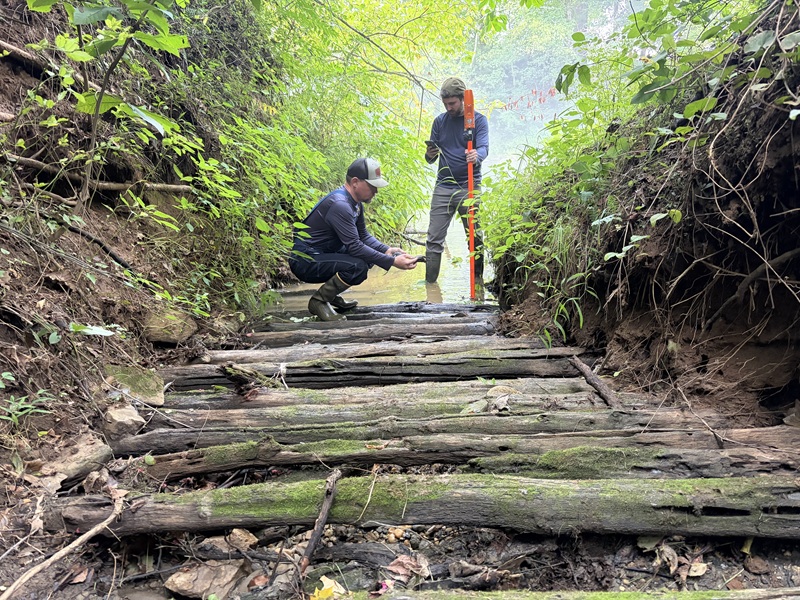
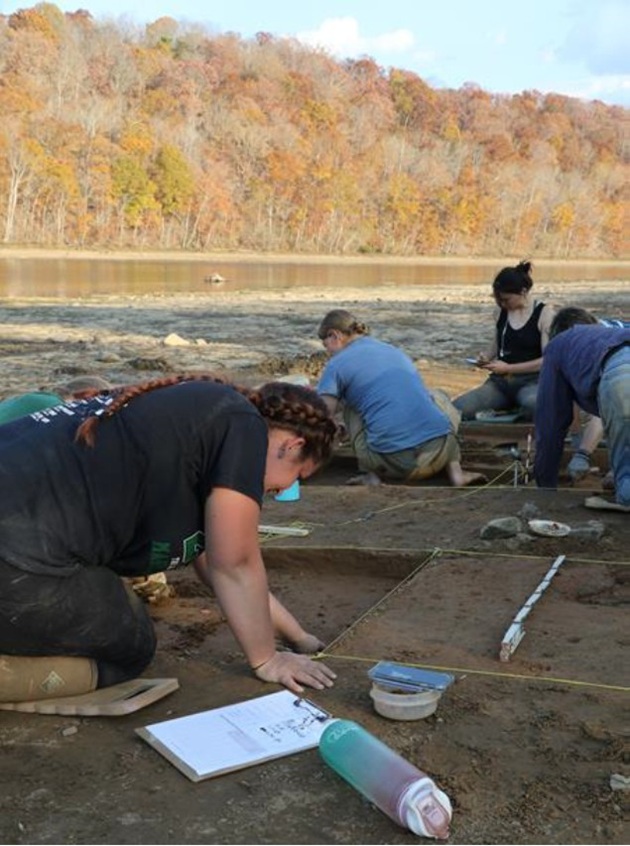
Decades after its dissolution, the once-vital railroad remains a through line between several listed landmarks and a broader historic landscape.
By Austin Walker | DHR National Register Program Manager
Chartered in 1882, the Atlantic & Danville Railroad formally began in 1885 as a narrow-gauge line running from Belfield and Hicksford (now Emporia) to a new wharf at the Surry County town of Claremont, with the goal of transporting lumber from southeast Virginia to the James River. When this initial venture proved unprofitable, investors raised money to build standard-gauge track from Emporia to a new deepwater port at West Norfolk in 1887. Between 1887 and 1891, this mainline was expanded 133 miles west to Danville, following a route through Brunswick, Mecklenburg, and Halifax counties that had previously been surveyed by the failed Norfolk and Great Western Railroad. In doing so, the Atlantic & Danville became immediately vital to the transport of processed tobacco and other manufactured goods from the Piedmont and Southside regions to ports along the Elizabeth River and on to international markets.
By 1899, the A&D had entered into a 50-year lease as part of the vast Southern Railway network. When this agreement ended in 1949, the railroad continued operating independently until 1962, when it was purchased by Norfolk & Western and reorganized as the Norfolk, Franklin, and Danville Railway, remaining in service until the merger of the Norfolk & Western and Southern Railways in 1982. Decades after the Atlantic & Danville’s dissolution, however, retracing the railroad offers a unique lens through which to view significant elements of Mecklenburg County’s built environment.
Founded in 1818 at the confluence of the Roanoke and Dan Rivers, the town of Clarksville initially flourished as a result of extraordinary, publicly funded navigational improvements that facilitated the river transport of tobacco from Southside Virginia to Norfolk. By 1836, Clarksville was a bustling river town, serving as the market for more than one-third of Mecklenburg’s tobacco production and much of the region’s skilled labor; by 1854, it was reported to have grown more than any other town in the state over the previous decade. The arrival of the Atlantic & Danville just prior to the turn of the 20th century further cemented the town as an economic center and aided its recovery following a devastating fire in 1893. Today, the town’s historic commercial core along Virginia Avenue reflects a variety of late 19th and early 20th century architectural styles, with many buildings featuring elaborate brick, wood, and sheet metal cornices and pediments. Heading west from Clarksville, the Atlantic & Danville also passed through the small community of Buffalo Junction, where a branch line to the Buffalo Lithia Springs once originated.
Pictured below: Virginia Avenue in Clarksville, illustrating the variety of early 20th century commercial architecture in the town. (Photos by David Edwards/DHR, 2025)


Similarly, the county seat of Boydton saw an economic resurgence with the arrival of railroad at the close of the 19th century. Though chartered in 1812, the town had housed the county courthouse since 1770 and prospered as a social and economic center by the early 19th century. In particular, the equine industry in Southside, the establishment of the original Randolph-Macon College nearby, and the town’s location along the stagecoach line from Belfield to Danville drove considerable commercial activity in Boydton. However, the ill-fated Boydton and Petersburg Plank Road, which was deemed unsafe within a decade of its 1853 completion, proved a major economic setback and increased calls for a rail line to come directly through the county seat. With the construction of the Atlantic & Danville line, Boydton saw a near-immediate upswing, with the town recentered within Southside’s brightleaf tobacco economy and further elevated by a burgeoning local lumber industry.
In addition to dramatically reshaping Mecklenburg’s established towns, the Atlantic & Danville also drove significant new development in the county. The town of South Hill was directly planned by railroad financiers and engineers in 1889, with 56 acres of land platted in a 1.25-mile circle around a new depot in advance of the A&D’s arrival in 1891. The town was incorporated in 1901, and by 1903, it housed seventeen businesses, three hotels, fifteen dwellings, and four warehouses. By 1913, six passenger trains and four freight trains served South Hill daily, firmly establishing the town as a significant tobacco market, manufacturing and shipping hub, and entertainment destination.


The town of La Crosse also emerged as a direct result of the Atlantic & Danville, which arrived in what was then a small village known as Piney Pond in 1889. Following the construction of Seaboard Air Line tracks through La Crosse in 1900, the town became an important confluence of two major transportation routes, with travelers able to proceed north, south, east, or west, and as many as eight passenger trains stopping there daily. Today, the ca.-1917 La Crosse Hotel remains an important landmark of the town’s prominent railroad legacy.
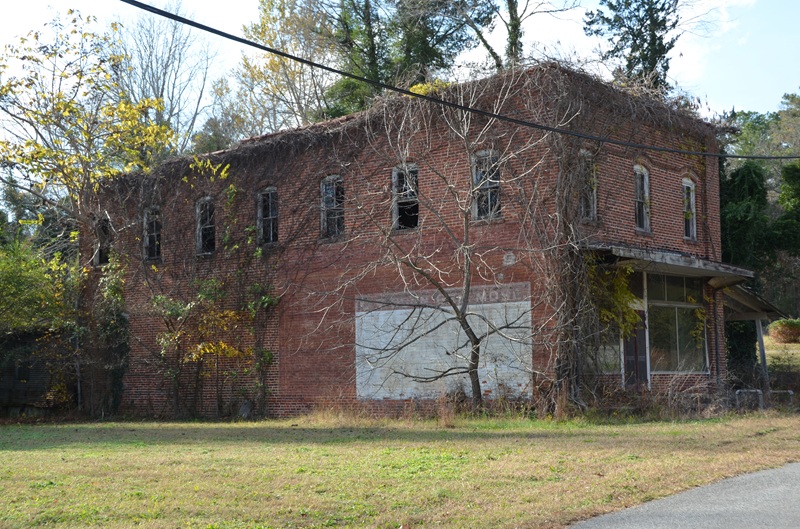
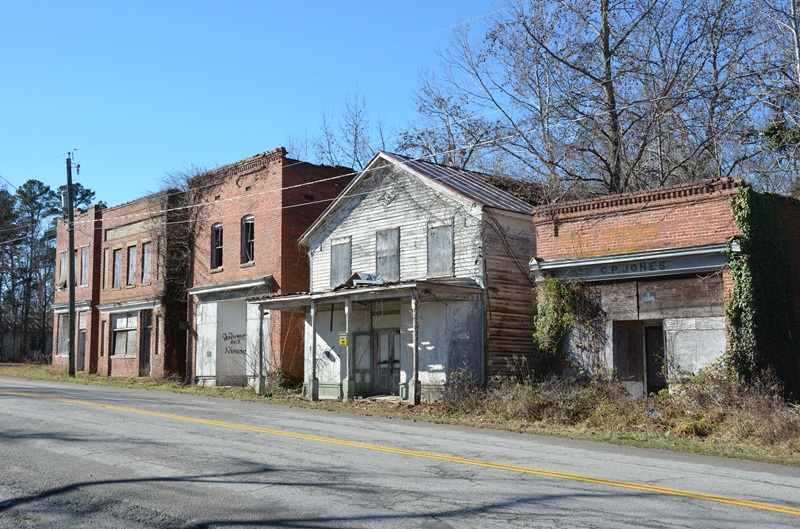
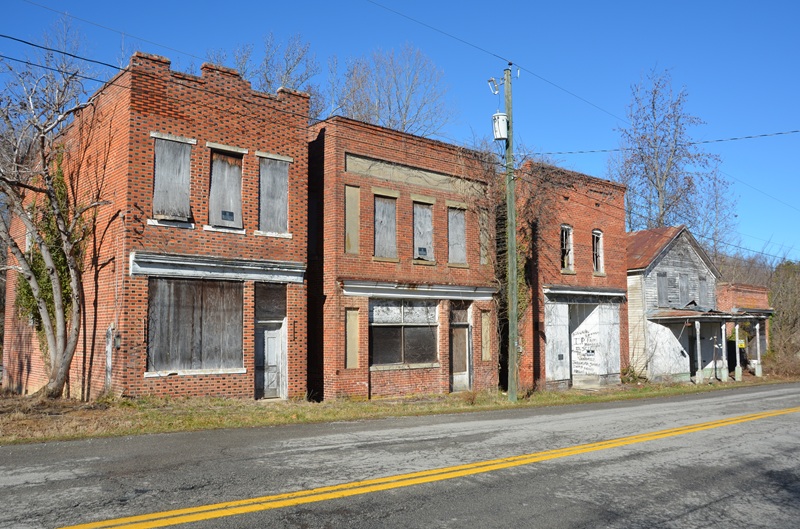
Beyond this small network of listed landmarks, retracing the Atlantic & Danville line, particularly in the area between South Hill and Boydton, reveals much more about the early 20th century landscape of Mecklenburg County. Perhaps the most striking example is the former town of Union Level, located about six miles west of South Hill. First established in the mid-19th century, Union Level’s heyday followed the arrival of the Atlantic & Danville, with a small commercial downtown developing around the town’s depot and post office during the first decades of the 20th century. By 1920, Union Level housed more than 20 businesses, including four general stores as well as a bank, pharmacy, boarding house, and dance hall.


However, both the immediate impacts of the Great Depression and the slow decline of the rail industry meant that many of the businesses had been shuttered by the 1970s. Today, while the depot and post office are no longer extant, a row of five distinctive commercial buildings remains in the former downtown. One still bears the name of proprietor C.P. Jones on an ornate sheet metal cornice, while another retains a barely legible sign that reads “Bank of Union Level.” Notably, the southernmost building even features a Flemish bond brick façade with glazed headers.
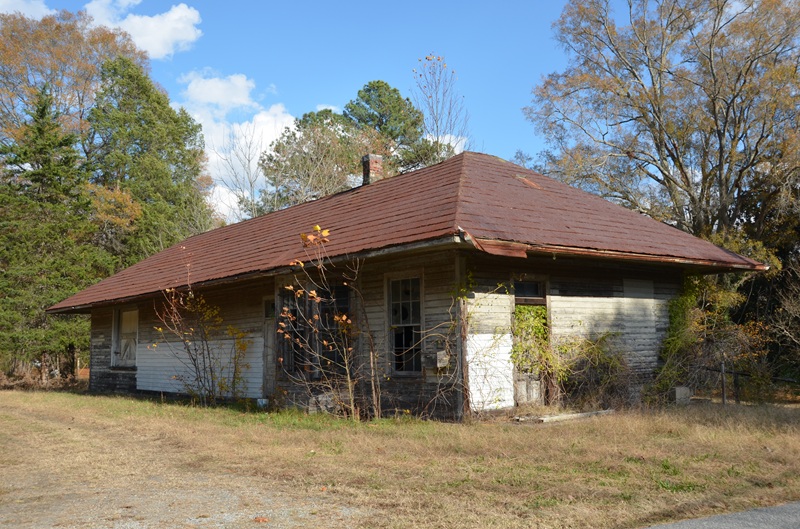
Although the train station at Union Level no longer remains, two other rural depots in the vicinity do survive. About four miles southwest, the former Atlantic & Danville station at Baskerville still stands, nestled in what is now a quiet hamlet. Though modest, the building appears to have accommodated both passenger and freight service. A lone historic commercial building also survives just across the street, with painted signage reading, “Dunn General Merchandise.”
Pictured below: Surviving commercial buildings in the former downtown Union Level. (Photos by Austin Walker/DHR, 2026)
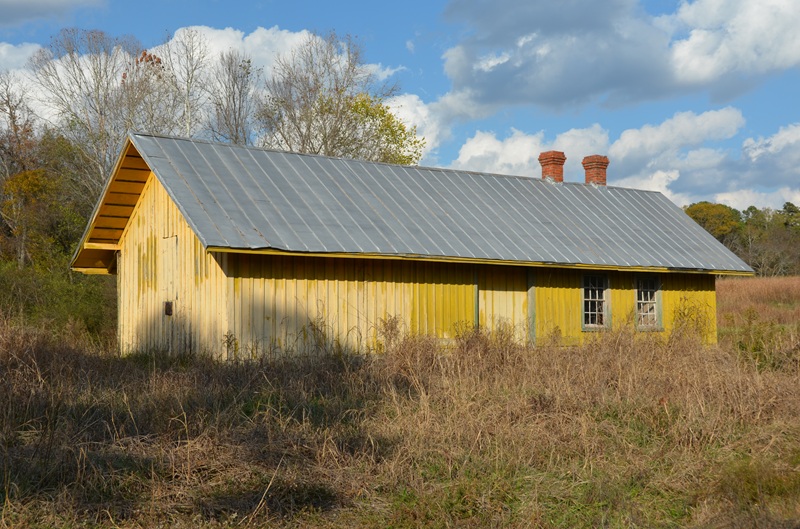
Roughly three miles further southwest, just south of Highway 58, sits the former Atlantic & Danville depot at Antlers. Now alone in open field just off the roadside, the building historically served as a hub for construction materials headed to the John H. Kerr Dam during the late 1940s and early 1950s, with the Atlantic & Danville building a dedicated branch line for the project. The dam’s construction resulted in the formation of Buggs Island Lake, which dramatically reshaped both the landscape and the tourism industry around Clarksville during the second half of the 20th century.
The architectural legacy of the Atlantic & Danville Railroad is by no means limited to Mecklenburg County. The railroad was pivotal to the development of Lawrenceville, for example, as well as the former Nansemond County town of Holland (now a neighborhood within the City of Suffolk). The nearby former A&D stops at Brodnax and Virgilina still retain their historic depot buildings, as do the communities of Drewryville and Capron in Southampton County. However, the relative richness of surviving resources throughout Mecklenburg County makes it an excellent point of departure for understanding the complex history connected by a single line on the map.